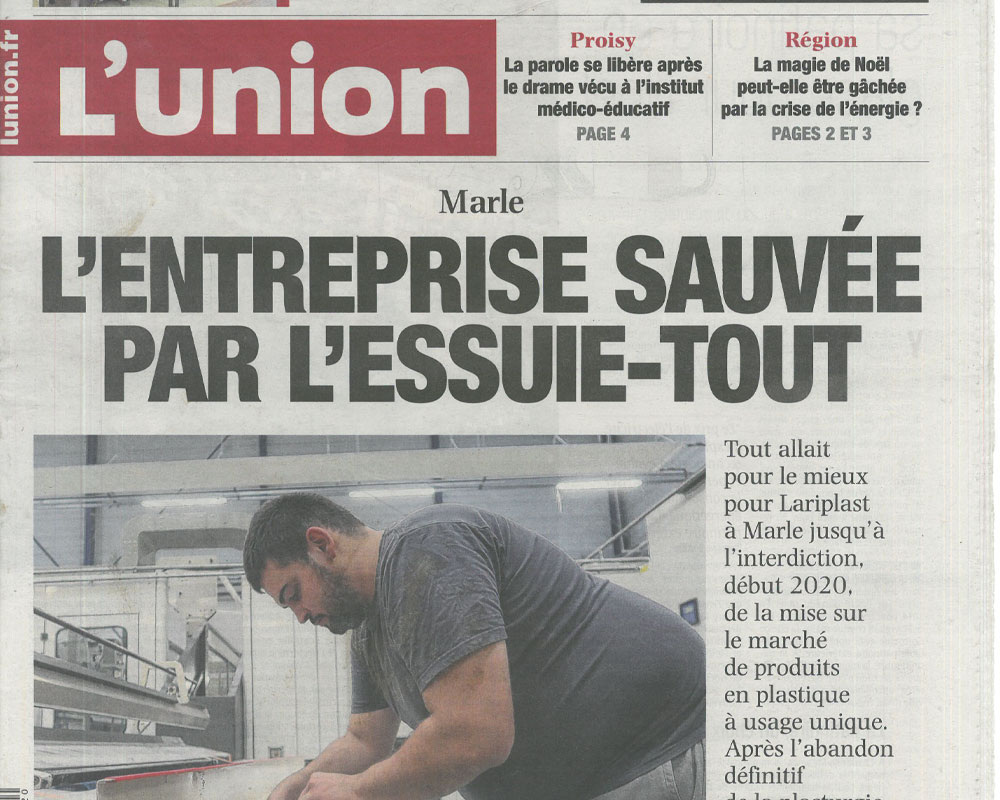
The company was saved thanks to paper towels,
Everything was going well for Lariplast in Marle until the ban on the sale of single-use plastic products took effect in early 2020.
After completely abandoning the plastics industry, the company successfully pivoted to producing paper towels.
From plastic cups to paper towels: Lariplast’s surprising pivot
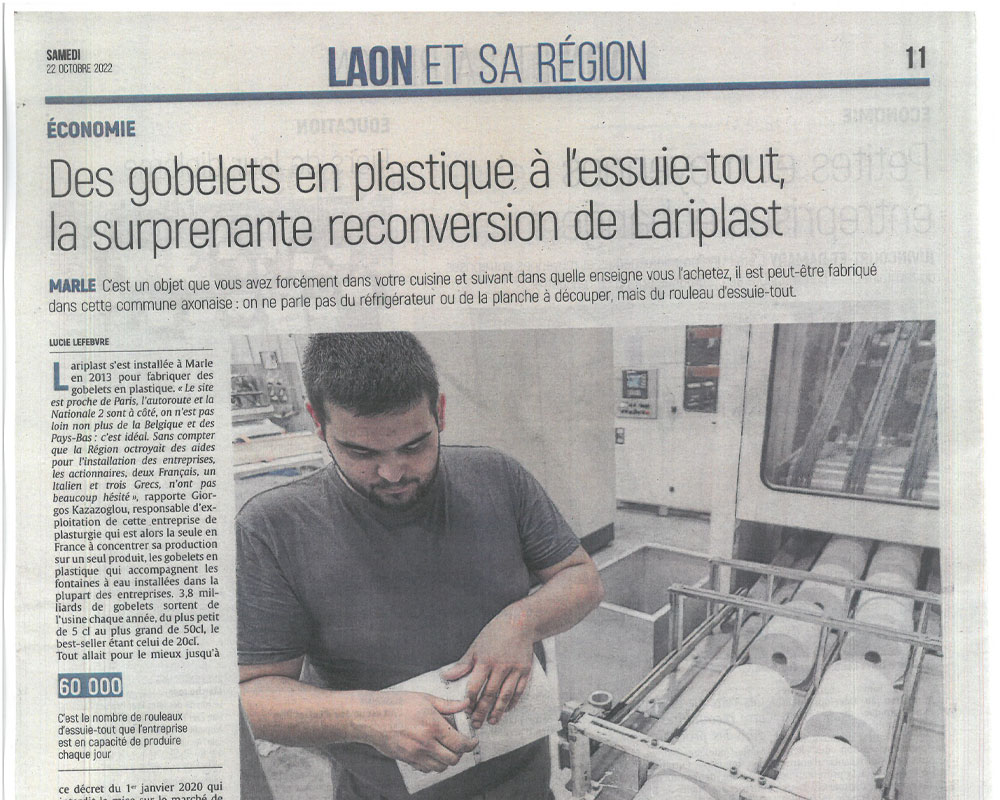
MARLE It’s an essential item in your kitchen, and depending on the brand you buy, it might be made right here in this city: we’re not talking about the refrigerator or the cutting board, but the roll of paper towels.
LARIPLAST set up operations in Marle in 2013 to manufacture plastic cups. “It’s close to Paris, the highway and the N2 are right nearby, and we’re not far from Belgium and the Netherlands. It’s the ideal location, not to mention that the region offered business relocation incentives; the shareholders—two French, one Italian, and three Greek—didn’t hesitate for long,” says Georges Kazazoglou, director of operations at this plastics company, which was then the only one in France to focus its production on a single product: the plastic cups that come with the water fountains installed in most companies. 3.8 billion cups roll off the production line each year, ranging from the smallest (5 cl) to the largest (50 cl), with the 20-cl size being the best-selling. Everything was going well until the decree of January 1, 2021, banning the sale of single-use plastic products.
60,000 That is the number of rolls of paper towels the company is able to produce each day.
“We knew this was coming, but we didn’t expect it to happen so quickly. It was a disaster. Then came COVID. We thought the health crisis would revive demand for single-use products,” recalls Giorgos Kazazoglou, who arrived in Marle in September 2016. In the end, that didn’t happen. To prevent their company from going under, the shareholders changed course. They decided to invest in converting the production lines and manufacturing cups made of PLA (a polymer derived from cornstarch). This time, it was Europe that stood in their way. In an effort to reduce waste overall, the company is taking new measures against plastic, including bioplastics. Even though they don’t contain chemicals, they aren’t biodegradable. “€300,000 down the drain,” concludes the company’s manager.
In February 2021, plastic production ceased permanently; the two production lines were sold to the United States, while new machines for manufacturing hand towels arrived in Marle from Italy.
Why this product? “Why not?” laughs Giorgos Kazazoglou. After a few adjustments, production truly kicked off in March 2021. It is carried out by fifteen employees.
Up to 60,000 rolls of paper towels are produced each day—enough to fill four semi-trailers.
Lariplast sells its entire production to a customer in the Netherlands who supplies stores in that country, as well as in France, Belgium, and Luxembourg.
STAND OUT AND GROW
The shareholders of Lariplast—now consisting of three Greeks and one Italian—are seriously considering setting up a second production line at the Marl plant.
Employees will be able to produce even more paper towels, as well as toilet paper. “To achieve this, we need to expand and build a new facility for storage. Currently, our capacity for raw materials is limited,” notes Giorgos Kazazoglou, who is set to finalize the purchase of a plot of land in the La Prayette neighborhood, near the production plant.