
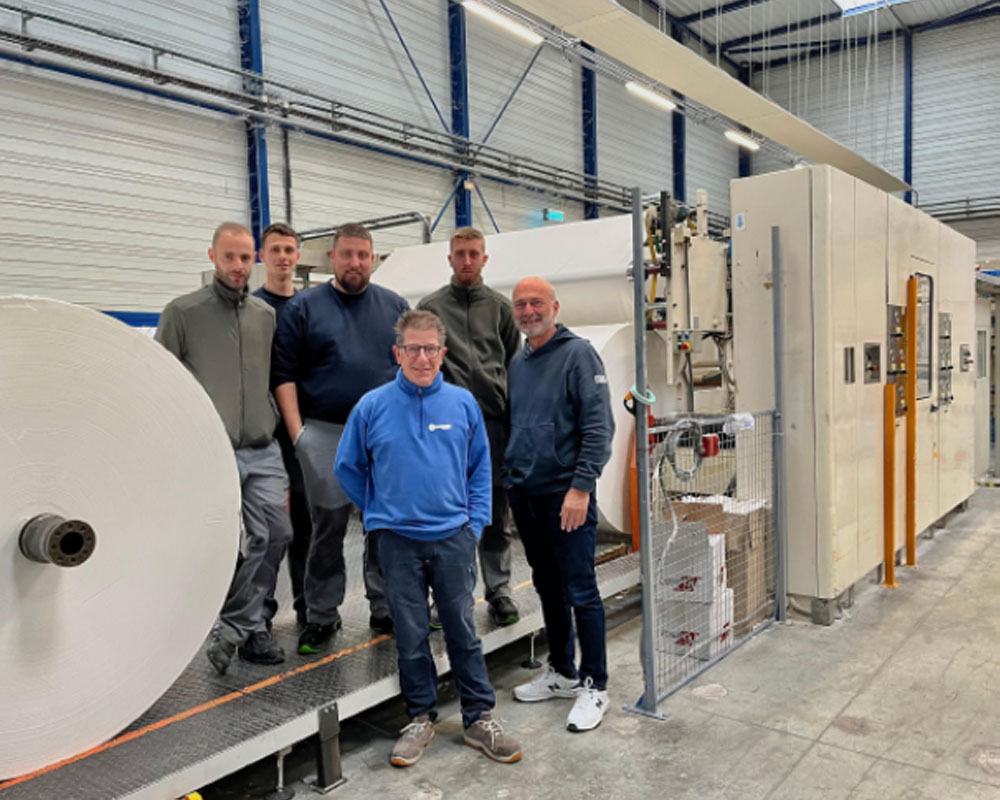
The ban on the circulation of single-use plastics has had a major impact on the plastics company based in Marle. To survive, it has turned to paper towels. We look back at this conversion.
Some people don’t even know that there’s a Lariplast company and that it’s based in Marle,” laughs Giorgos Kazazoglou, manager of the company of the same name.
However, the company is now operating at full capacity and preparing new projects, despite going through a “very complicated” period. It was a period of transition after the legislator called into question the production of plastics. For Lariplast, plastics production will cease in February 2021. But it was before that date that we had to look for a sustainable alternative. “One of our shareholders had a paper production line and we had space in the factory. With infinite determination to save the company, they chose this one, to install this paper towel machine. “It took six months to get it up and running, and our first trucks were sold three months later, in March 2021”, explains the operations manager. At the same time, the plastic cup machines were sold in the United States.
“The day-to-day running of the company has been transformed, and today we know that everything is fine” Giorgos Kazazoglou. This transition was not without its difficulties. “Our employees were trained in plastics processing. Everything changed for them: production, productivity, and recruitment. So, we had to offer training so that they could use the machines. Lariplast has not made any employees redundant. What Giorgos Kazazoglou acknowledges is that the government imposed this transition but also provided the company with financial support, at least at a minimum level.
The transition caused a series of problems since the training courses led to absences from the company. You must replace those who train.
A ‘FORCED’ BUT SUCCESSFUL CONVERSION
The very organisation of the company has changed: “We used to have two production lines and two people on each, a team leader and an assistant. When we switched to paper towels, the assistant position was abolished. It was impossible for us to choose between two employees who would keep the job of team leader. So, we put everyone on the same level and decided to rotate them. As a result, they are in rotation on all the machines (production, palletising, filming) and combine their skills to handle the new equipment perfectly.
Can we now consider that the company’s ‘forced’ conversion has been completed? Giorgos Kazaoglou proudly replies: “Yes, 100%. Employees, shareholders, and customers have all forgotten about plastic.
The company’s mindset has changed. We know that everything is going well, we can smile and go even further. As proof of this, Lariplast has become so profitable that it has taken on three employees and is planning new projects, including the creation of two 3,000 m2 storage buildings.
A second production line is also being installed to produce more paper towels and toilet paper. Currently, the two teams at Lariplast in Marle produce 140 pallets of 400 rolls, equivalent to 56,000 paper towels a day.
In the Aisne since 2013
Lariplast originally set up in Aisne in 2013, “as the only plastics company in France to produce just one product, plastic cups for company water coolers”, explains Giorgos Kazazoglou.
At the time, according to the French authorities, Lariplast held around 45% of the market, producing 3.8 billion cups a year. Then the legislator intervened to change the regulations on plastic. The final blow came on 1 January 2020, when the circulation of single-use plastic products was banned.
The company is adapting, “there is no way the Greek shareholders are going to abandon this plant”, insists the manager.
The production lines were modified to produce organic plastic. The investments soon proved to be unnecessary, however, as Europe in turn passed legislation banning bioplastics on the grounds that they are not biodegradable.
The covid also had consequences, forcing the company’s employees into lay-off.
“EVERYTHING IS RECOVERED
Lariplast has stopped using plastic to comply with the decree of 1 January 2020. But that’s not all: the management of its waste is also subject to an ecological approach. “Everything is recycled”, with jammed or damaged rolls taken back and sold in Italy.
Wastewater is treated by an external plant. As for electricity, Lariplast plans to install photovoltaic panels.
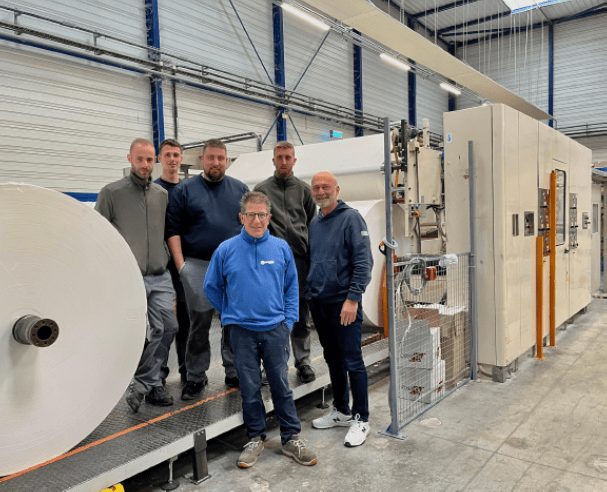
De gauche à droite : Thomas Tronquoy, Théo Vanhede, Kevin Dumenil, Axel Tant, Nicolai Sauro et Giorgos Kazazoglou, les salariés et le responsable de l’exploitation.